
Over 50 percent of sewer backups in Los Angeles are triggered by aggressive tree roots invading aging underground pipes. Slow drains? Gurgling toilets? When dealing with tree roots in sewer line Los Angeles systems, your property faces an immediate threat. The fear of raw sewage backing up into your home is completely justified. Waiting only makes the structural damage worse. You need a fast, decisive solution right now before a total mainline blockage forces a major emergency crisis.
It's stressful to worry about hidden excavation costs or feel confused about whether you need a standard rooter service versus heavy-duty hydro jetting. You deserve a clear diagnosis of your pipe condition and immediate relief from sluggish drains. This guide identifies the critical warning signs of root intrusion and outlines the fastest professional methods to clear your line safely before a total backup occurs. Discover the high-powered mechanical solutions that destroy current blockages and stop roots from returning next month.
Key Takeaways
- Spot the warning signs like persistent gurgling and slow drainage. Act early to prevent a full-scale sewage disaster in your home.
- Understand how seismic shifts and clay pipes make tree roots in sewer line Los Angeles a frequent crisis. Local conditions require specialized mechanical solutions.
- Avoid corrosive chemical root killers that damage your infrastructure. Rely on professional-grade tools to clear blockages without risking pipe integrity.
- Compare rooter service with 4,000 PSI hydro jetting. Choose the method that provides long-term relief instead of a temporary patch.
- Master the emergency protocol for a sudden backup. Knowing where to find your cleanout and when to stop water flow saves your property.
Recognizing the Warning Signs of Tree Root Intrusion
You see the water rising. You hear the pipes protest. Dealing with tree roots in sewer line Los Angeles properties isn't just a nuisance; it's an infrastructure emergency. Early detection saves you from a total home flood. Look for these specific indicators before the backup becomes irreversible. A proactive response now prevents a costly excavation later.
The "Gurgle" Test: Your Pipes Are Talking
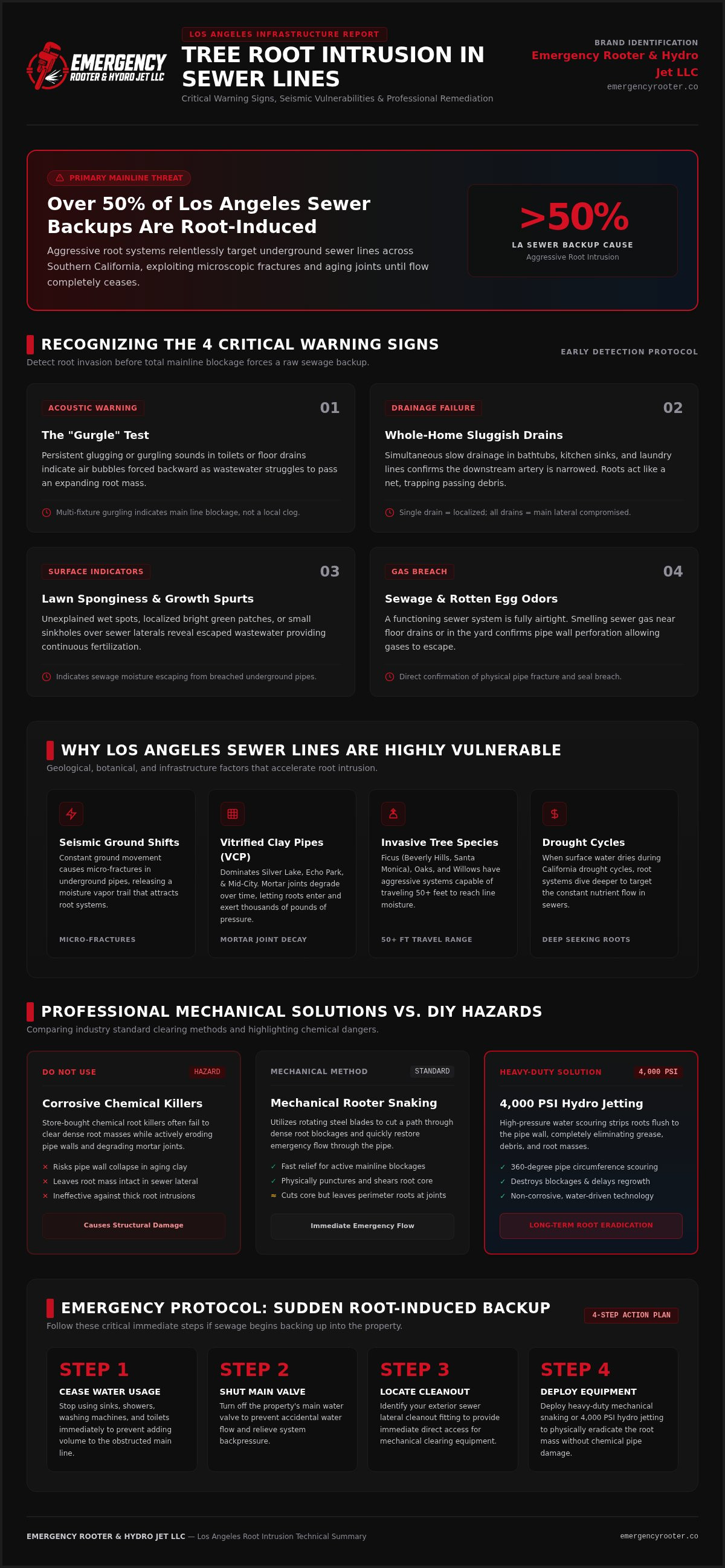
Listen to your drains. Persistent gurgling sounds from your toilet or floor drains indicate trapped air. As water tries to pass a root mass, air bubbles are forced back up the system. This creates a distinct, rhythmic glugging sound. A local clog in one sink won't cause your toilet to bubble. If multiple fixtures gurgle when you flush or run the laundry, you have a main line obstruction. Root invasion typically occurs at pipe joints where moisture escapes, attracting thirsty roots. Stop using water immediately if you hear these sounds in your basement or crawlspace. Shut off the main valve to prevent further pressure on the blockage.
Slow drainage across your entire home is the most common early warning. If the bathtub, kitchen sink, and laundry line all struggle to clear simultaneously, the problem is downstream. A single slow drain is usually hair or grease. Multiple slow drains mean the main artery is constricted. In Los Angeles, where aging clay pipes are standard, roots act like a net, catching debris and narrowing the pipe diameter until flow stops completely.
Surface Signs in Your Yard
Your lawn often reveals what's happening underground. Look for unexplained wet spots or patches of grass that are suddenly lush and bright green. In our dry climate, a localized growth spurt usually means a sewer leak is providing constant fertilization. You might also notice small sinkholes or soft, spongy earth directly over your sewer lateral. Certain species are notorious "hunters" for sewer moisture. Ficus, Willow, and Oak trees are common in Los Angeles and possess aggressive root systems that can travel 50 feet or more to reach a pipe. Root intrusion is a gradual but relentless structural failure. Once a root hair enters a microscopic crack, it expands, eventually shattering the pipe wall.
Identify breaches using the "sewage smell" test. A healthy sewer system is airtight. If you smell rotten eggs or raw sewage in your yard or near floor drains, the line is breached. Roots have already cracked the pipe, allowing sewer gases to escape. This is a clear signal that the structural integrity of your line is compromised and requires immediate professional intervention.
Why Los Angeles Sewer Lines Are Vulnerable to Root Damage
Los Angeles sits on a shifting foundation. Our ground is constantly moving. These seismic shifts create micro-fractures in your underground infrastructure that you can't see from the surface. These tiny cracks release a vapor trail of moisture into the surrounding soil. Thirsty tree roots detect this trail instantly. They follow the humidity like a heat-seeking missile. Once they find the source, they don't stop. Dealing with tree roots in sewer line Los Angeles systems is a constant battle against geography and biology. The environment under your lawn is a perfect storm for pipe failure.
The Clay Pipe Vulnerability
Vitrified Clay Pipe (VCP) dominates older neighborhoods like Silver Lake, Echo Park, and Mid-City. It's a heavy-duty material, but it has a fatal flaw: the joints. Most VCP systems were installed decades ago using mortar joints. Over time, that mortar degrades and becomes porous. Roots enter these microscopic gaps with surgical precision. Once inside, the environment is ideal. It's warm. It's dark. It's full of nutrients. The roots expand rapidly, exerting thousands of pounds of pressure. This expansion eventually shatters the brittle clay from the inside out, leading to total structural collapse.
LA Tree Species and Their Root Systems
Not all trees are equal. Some are aggressive hunters. Ficus trees in Beverly Hills and Santa Monica are notorious for their invasive nature. They have shallow, wide-reaching root systems that prioritize moisture over stability. They'll travel 50 feet to find a single crack. California Oaks are another primary threat. Their taproots dive deep into the soil, seeking stable water sources during the 2026 drought cycles. Southern California's soil composition, often a mix of dense clay and loose sand, allows these roots to travel long distances without much resistance.
The 2026 drought has intensified this problem across the basin. When surface water disappears, roots look deeper. They sense the constant flow of your sewer line. It's a reliable water source that never dries up. If you suspect an intrusion, securing a professional sewer line repair assessment is the only way to confirm the damage before your yard becomes a swamp. Seismic activity adds another layer of risk. Even minor tremors shift the soil around your lateral. These shifts pull at pipe segments and open gaps in the joints. A gap of just one-eighth of an inch is enough for a root hair to enter. Once that hair is in, the pipe's fate is sealed without professional mechanical intervention.
The Danger of DIY Chemical "Fixes" for Sewer Roots
Stop reaching for the jug of blue crystals. Pouring store-bought herbicides down your drain is a gamble you'll likely lose. When you have tree roots in sewer line Los Angeles systems, you're facing a dense, woody obstruction. Chemicals can't cut wood. They might burn the outer layer of a root mass, but the core remains intact. You're just delaying the inevitable backup while risking your plumbing's health. These products often contain copper sulfate or harsh lye. They're corrosive. They're dangerous. They don't solve the structural breach.
Why Chemicals Fail the Mechanical Test
Roots usually enter through the top or sides of pipe joints. Liquid chemicals flow along the bottom of the pipe due to gravity. They never even touch the primary intrusion point. It's a waste of money. Even if the chemical kills a small portion of the root, you're left with the "hairball" effect. Dead roots don't dissolve; they turn into a brittle, sticky mesh. This mesh acts like a filter, trapping fats, oils, and debris. You end up with a solid plug that is harder to clear than the original living roots. Chemical treatments are a temporary band-aid for a permanent structural wound.
Los Angeles has strict environmental regulations regarding what goes into the sewer system. High concentrations of copper sulfate can disrupt local water treatment processes and harm aquatic life. Beyond the environment, these chemicals pose a direct threat to your home. They can cause chemical burns to your skin during a backup. They also eat away at older cast iron pipes and degrade the mortar in clay joints. You might kill a few roots, but you'll end up with a collapsed line that requires total replacement.
The Professional Alternative
Mechanical removal is the only way to restore full flow. You need to physically cut the roots or blast them out with high-pressure water. Before you try any treatment, you must see the problem. A professional camera inspection identifies the exact location and severity of the intrusion. It tells us if the pipe is still structurally sound or if it's on the verge of collapse. Don't guess with your home's infrastructure. Get a professional diagnostic scan now to see exactly what's blocking your pipes. Dealing with tree roots in sewer line Los Angeles requires heavy-duty equipment, not a bottle from a hardware store shelf. We use precision tools to clear the path and verify the results instantly.
Rooter Service vs. Hydro Jetting: Clearing the Line
You have a decision to make. One path provides a quick fix. The other delivers a total system reset. When you're battling tree roots in sewer line Los Angeles systems, the method you choose determines how soon you'll be calling a plumber again. Mechanical clearing is mandatory. Chemicals won't work. You need to decide between the brute force of a mechanical auger and the precision of high-pressure water.
When to Choose Rooter Service
Rooter service, or snaking, is our first-response tool for total blockages. We use a heavy-duty steel cable with a rotating cutting head. This machine is designed to punch a hole through solid obstructions. It's the best option for immediate "get it flowing" emergencies. If your pipes are extremely old or structurally fragile, a snake might be the safer choice to avoid further damage from high-pressure water. However, snaking has a significant drawback. The blades only cut through the center of the root mass. They leave behind root "stubs" along the pipe walls. These stubs act like Velcro, catching grease and debris. In the nutrient-rich environment of an LA sewer, these stubs often grow back faster and thicker than before.
The Hydro Jetting Advantage
Hydro jetting is the gold standard for long-term pipe health. We use specialized nozzles to blast water at 4,000 PSI in a 360-degree pattern. This doesn't just clear a path; it scrubs the pipe walls until they're surgically clean. It removes every root hair, every layer of hardened grease, and every bit of mineral scale. When facing aggressive tree roots in sewer line Los Angeles, hydro jetting is the only way to ensure the pipe is truly clean. This process also prepares the pipe for trenchless relining if the structural damage is severe. While the initial service is more intensive, the long-term cost benefits are clear. You reduce the frequency of service calls and prevent the roots from gaining a foothold. Schedule a professional hydro jet cleaning now to clear your line for good and stop the cycle of recurring backups.
Our team arrives in an average of 45 minutes to evaluate your system. We use professional-grade equipment to match the solution to your pipe's specific condition. Don't settle for a temporary fix that leaves your home vulnerable next month. Choose a method that restores full capacity and protects your property from future sewer failures.
Emergency Response: How to Handle a Root-Induced Backup
Water is rising in your shower. The toilet is overflowing. Raw sewage is spilling onto your floor. This is an infrastructure emergency. You don't have time for a slow response. When dealing with tree roots in sewer line Los Angeles systems, the damage happens in minutes, not hours. You must act decisively to protect your property and your family's health. Follow these steps immediately to contain the crisis.
- Step 1: Stop all water usage. Every gallon you pour down a sink or flush down a toilet is another gallon that will end up on your floor. Turn off the main water shut-off valve. Stop the dishwasher. Stop the laundry.
- Step 2: Locate your main sewer cleanout. Look in your front yard or near the sidewalk for a plastic or metal cap. This is the access point for our equipment. Clearing the area around it saves precious minutes when we arrive.
- Step 3: Clear the backup area. Move rugs, furniture, and electronics away from the affected drains. Keep pets and children away from the standing water.
- Step 4: Call a 24/7 specialist. You need a technician with heavy-duty mechanical tools, not a general handyman.
Immediate Mitigation Steps
Raw sewage is a biohazard. It contains bacteria, pathogens, and viruses. Do not attempt to clean the spill while the line is still blocked. Turning off the main water valve is your most critical first step because it prevents accidental water usage from other household members. When you call our dispatcher, be specific. Tell us if multiple fixtures are backing up simultaneously. Mention if you have large Ficus or Oak trees near your sewer lateral. This information ensures we dispatch a truck equipped for tree roots in sewer line Los Angeles challenges, complete with the right mechanical cutters and high-pressure nozzles.
What to Expect During the Service Call
We treat every backup like a first-responder call. Our 45-minute average arrival time means help is on the way now. We don't guess. We perform a rapid camera scan to see the exact nature of the blockage. We identify the specific point where roots have breached your clay or cast iron pipes. Once the diagnosis is clear, we deploy professional-grade rooter blades or hydro jetting systems to restore flow immediately. We stay until the line is clear and your home is safe. Call Emergency Rooter & Hydro Jet LLC for 24/7 relief. Our teams are standing by with equipment in hand, ready to resolve your sewer crisis right now.
Restore Your Main Line and Protect Your Property
Don't let a slow drain turn into a total property disaster. Persistent gurgling and multiple sluggish fixtures are clear signals of a breach. You've learned that chemical cleaners fail the mechanical test. They can't dissolve the woody mass currently narrowing your pipes. Mechanical intervention is the only solution that works. Whether you need immediate rooter service to restore flow or high-pressure hydro jetting to scrub your pipes clean, acting now prevents a catastrophic sewage backup.
Dealing with tree roots in sewer line Los Angeles systems requires a specialist who understands local clay pipe vulnerabilities. We provide total command over these chaotic situations with professional-grade equipment. With over 10,000 jobs completed and a licensed and insured team (CA #574013), we stand ready to act. We maintain a 45-minute average response time to ensure your home stays dry and safe. You can resolve this disruption today.
Emergency Sewer Backup? Call Our 24/7 Los Angeles Team Now
Frequently Asked Questions
How much does it cost to remove tree roots from a sewer line in Los Angeles?
Pricing for removing tree roots in sewer line Los Angeles systems is determined on a per-job basis. The final cost depends on the severity of the plumbing failure and the specific equipment required to restore flow. Factors like pipe depth, material, and the extent of the root mass influence the scope of work. We perform a diagnostic visit to provide an accurate assessment of your specific sewer crisis.
Can I use salt or chemicals to kill roots in my sewer line?
You should avoid using salt or store-bought chemicals as they rarely solve the underlying problem. These substances often flow past the root mass without clearing the blockage. They can also corrode older cast iron pipes and damage the environment. You need a mechanical solution to physically remove the obstruction and restore full flow. Chemicals are a temporary band-aid for a permanent structural wound.
How do I know if the clog is in my line or the city of Los Angeles main?
Check if multiple fixtures in your home are backing up at once. If your neighbors are also experiencing sewage overflows, the problem is likely the city main. If the backup is isolated to your property, the responsibility falls on you. Los Angeles property owners are responsible for the entire sewer lateral from the building to the street connection, including the portion under the sidewalk.
Will a rooter service damage my old clay pipes?
Professional rooter service is safe when performed by experienced technicians using the right equipment. We use specialized blades designed to cut roots without shattering fragile vitrified clay. However, if the pipe is already severely collapsed, we may recommend alternative methods. A camera inspection is the first step to ensure the structural integrity of your line before we begin any mechanical clearing process.
How often should I have my sewer line cleaned if I have large trees?
Schedule a professional cleaning every 12 to 24 months to prevent recurring tree roots in sewer line Los Angeles issues. Aggressive species like Ficus or Oak trees require more frequent monitoring. Regular maintenance prevents small root hairs from expanding into massive, pipe-bursting blockages. This proactive approach saves you from the distress and high costs associated with sudden, emergency sewage backups in your home.
What is the fastest way to clear a main sewer line backup?
Mechanical rooter service is the quickest method for immediate relief during a crisis. Our technicians arrive in an average of 45 minutes to punch through the obstruction and get water moving again. For a more thorough, long-term fix, we often follow up with hydro jetting to scrub the pipe walls clean. This combination ensures your system returns to full operational capacity as fast as possible.
Does homeowners insurance cover tree root damage to sewer lines?
Coverage varies significantly between different policies and insurance providers. Most standard homeowners insurance policies don't cover damage caused by wear and tear or root intrusion unless you have a specific service line rider. You should review your policy details or contact your agent to verify your specific coverage. Documenting the damage with a professional camera inspection report helps when filing potential claims.
Is hydro jetting safe for all types of sewer pipes?
Hydro jetting is safe for most modern pipes, including PVC and structurally sound cast iron. We adjust the water pressure to match the specific material and condition of your line. For extremely old, crumbling clay pipes, we exercise caution and may recommend a different mechanical approach. Our diagnostic camera scan determines if your infrastructure can handle high-pressure cleaning before we activate the equipment.


