

What if the repair that involves the least digging isn’t the right fix for your sewer line? With sewer line repair Los Angeles, start by finding out what’s actually wrong. A sewer camera inspection can reveal root intrusion, cracks, shifted joints, or a sagging section, helping match the repair plan to the pipe’s condition rather than relying on a one-size-fits-all approach.
It’s understandable to worry about where the damage is, how serious it may be, and whether fixing it means tearing up a yard or driveway. The right approach depends on the inspection findings, pipe location, and site conditions. Some problems call for a focused repair; others may require a larger section to be replaced. Trenchless methods can suit some lines, but they aren’t the answer for every pipe or property.
This guide explains how technicians assess sewer line damage, how common repair approaches compare, and what to expect as a project takes shape in Los Angeles. You’ll get a clearer picture of the diagnosis, the factors that shape the repair, and why the pipe’s condition should guide the decision.
Key Takeaways
- Learn how symptoms and a sewer line assessment help distinguish a temporary blockage from physical pipe damage.
- See how a camera inspection can help locate damage and guide a practical repair scope.
- Compare localized repairs, trenchless approaches, and open excavation by access needs, surface disruption, and suitability.
- Understand how property access and the project address affect planning and which local authority to check about permits for sewer line repair Los Angeles.
- Know what to document before arranging an assessment, and which project factors can shape the repair plan.
Sewer Line Repair in Los Angeles: What the Service Addresses
A sewer line carries wastewater away from a home or business through a buried building sewer pipe. Sewer line repair Los Angeles addresses physical damage or failure in that pipe, such as a crack, separated joint, or collapsed section. Work may focus on a defined area or involve a broader repair plan, depending on the assessment findings.
A blockage and a damaged pipe aren’t the same problem. Cleaning clears an obstruction; it doesn’t restore broken pipe material. If trouble returns after cleaning, or several fixtures are affected, the main line may need further assessment. These signs are reasons to investigate, not proof that the pipe is broken.
To see one example of a trenchless sewer replacement approach, watch this video:
When a sewer line problem may need repair
Look for patterns, not just one slow sink. Recurring backups that affect multiple fixtures, such as a toilet and nearby tub, can point to a problem farther along the shared main line. Slow drains, unpleasant odors, or unusually wet areas outdoors are also reasons to investigate, but each can have more than one cause. A fixture issue, local drain obstruction, or another plumbing problem may create similar signs.
Note where and when symptoms occur, which fixtures are affected, and whether the problem clears or returns. This record gives a technician useful context. If wastewater is backing up into occupied rooms, treat it as urgent: stop using water-producing fixtures and arrange emergency plumbing help promptly. Don’t wait for repeated flooding to establish a pattern.
Repair, cleaning, or replacement: understand the difference
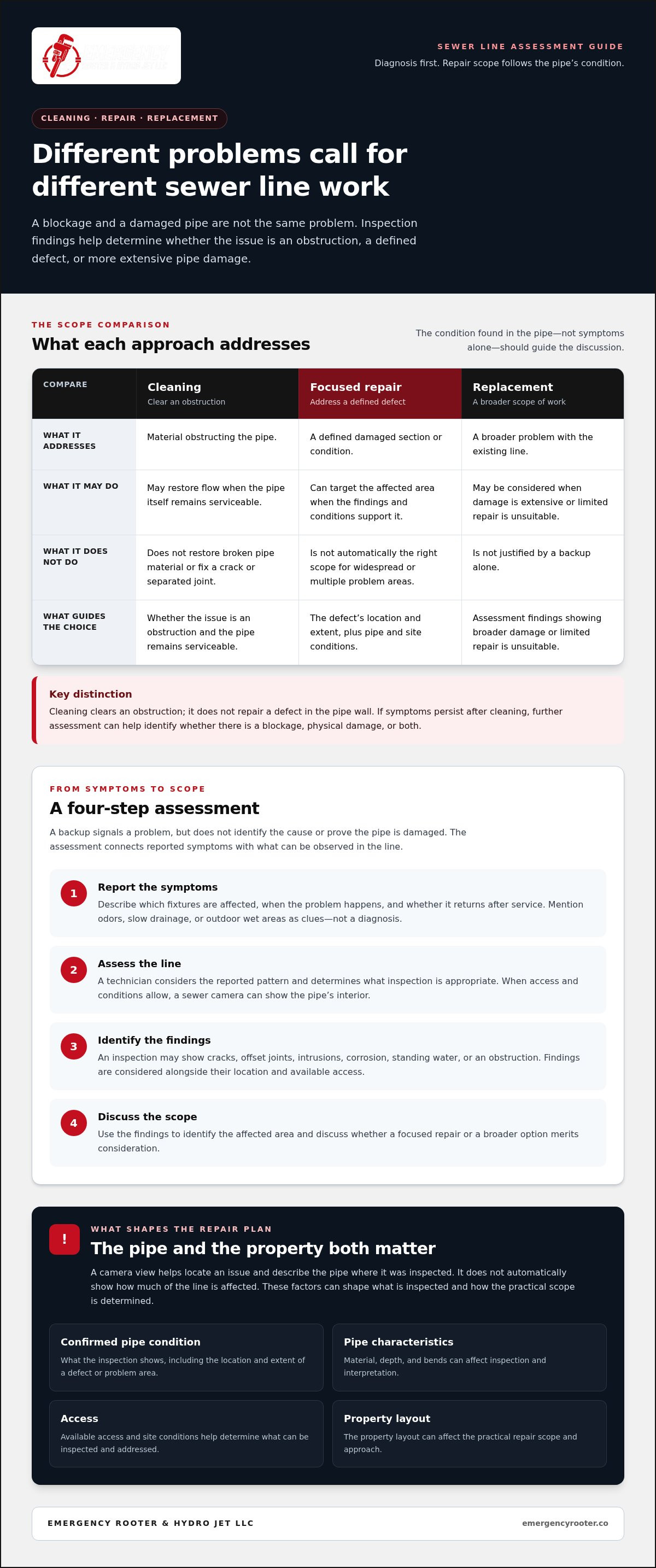
These terms describe different work. Cleaning removes material obstructing the pipe and may restore flow when the pipe itself remains serviceable. It doesn’t fix a crack, separated joint, or another defect in the pipe wall. If symptoms persist, an assessment can help determine whether the issue is a blockage, physical damage, or both.
Repair addresses a defined damaged section or condition. The scope depends on the problem’s location and extent, along with pipe and site conditions. Replacement is broader. It may be considered when an assessment shows extensive damage or that the existing line’s condition makes a limited repair unsuitable. A backup alone doesn’t mean replacement is necessary.
Diagnosis should come before method selection: the pipe’s documented condition should guide whether cleaning, a targeted repair, or replacement makes sense. This keeps the discussion focused on the cause and scope, rather than choosing a repair approach before the problem is clear.
How Sewer Line Damage Is Diagnosed Before Repair
A backup tells you something is wrong. It doesn’t identify the cause or prove the pipe is damaged. A careful assessment separates what’s visible from what’s suspected, then connects the findings to a repair scope. For sewer line repair Los Angeles property owners can make informed decisions by following a clear sequence instead of choosing a method based on symptoms alone.
The assessment typically moves through four steps:
- Report the symptoms. Describe which fixtures are affected, when the problem happens, and whether it returns after service. Mention odors, slow drainage, or outdoor wet areas, but treat them as clues rather than a diagnosis.
- Assess the line. A technician considers the reported pattern and determines what inspection is appropriate. When access and conditions allow, a sewer camera can travel through the pipe and show its interior.
- Identify the findings. The inspection may show a visible defect, an obstruction, or another condition that needs attention. The technician relates what appears in the pipe to its location and the available access.
- Discuss the scope. With the findings in hand, the repair plan can identify the affected area and explain whether a focused repair or broader option merits consideration.
What an inspection can reveal about the pipe
A camera view may show cracks, offset joints, intrusions, corrosion, or standing water inside the line. These observations help locate an issue and describe the pipe’s appearance at the point inspected. They don’t automatically show how much of the line is affected. Pipe material, depth, bends, and access can shape what the technician can inspect and how the findings are interpreted.
Surface signs matter, but they’re not proof of a specific failure. A sewer odor, recurring backup, or wet patch in the yard can have more than one explanation. The useful distinction is between the symptom you notice and the evidence found in the pipe. A clear account of both helps keep the assessment grounded.
How findings shape a repair recommendation
If the inspection points to a defined, localized defect, the discussion may focus on repairing that section where suitable. If it shows widespread deterioration or multiple problem areas, broader replacement may be considered. Neither conclusion should rest on a symptom alone. The confirmed condition, pipe material, depth, access, and property layout all affect the practical scope.
Ask for the recommendation to connect the observed condition to the proposed work. A useful explanation identifies where the issue is, what the inspection showed, and why the scope fits those findings. Repair recommendations should follow documented pipe findings, not assumptions drawn from surface symptoms. That gives you a sound basis for comparing options.
If you’re seeing active sewer trouble, arrange a sewer line assessment so the condition can be evaluated before a repair method is selected.
Sewer Line Repair Methods Compared: Trenchless Options and Excavation
Repair doesn’t automatically mean digging up the full sewer line or replacing every foot of pipe. The right scope depends on the confirmed damage, pipe condition, access, and property layout. In sewer line repair Los Angeles projects, surface disruption can vary widely: a targeted repair may require access to one area, while other conditions may call for a broader approach.
Use this comparison to understand the trade-offs. It’s a starting point, not a method recommendation. Inspection findings and site conditions determine what’s practical.
| Method type | Access needs | Likely surface disruption | May suit | Limits to consider |
|---|---|---|---|---|
| Localized repair | Access to the damaged area, which may require a small excavation | Usually focused around the repair location, though the exact area depends on depth and access | A defined, limited defect when the surrounding pipe is in suitable condition | Can be impractical if damage is widespread, difficult to reach, or near other weak sections |
| Trenchless approach | Access points and enough room for the method and equipment | May reduce the amount of surface opened compared with a continuous trench | Some lines with a suitable condition, configuration, and access | Not suitable for every pipe; the condition and layout can rule it out |
| Open excavation | Digging down to expose the affected pipe or work area | Can disturb landscaping, paving, or other surfaces along the excavation area | Cases where direct access is needed or the pipe condition calls for exposed work | Depth, obstacles, and restoration needs can increase the disruption |
When a localized repair may fit the documented damage
A focused repair may be considered when inspection identifies a specific defect and the surrounding pipe is suitable to remain in service. The damaged area still has to be reachable, and depth or nearby structures can affect how practical access will be. A limited repair addresses the documented condition; it doesn’t guarantee that other parts of an older or damaged line won’t need attention later.
When trenchless work or excavation may be considered
Trenchless approaches, such as lining or pipe bursting, may reduce how much of a surface needs to be opened in suitable conditions. They still require workable access and depend on the pipe’s condition and configuration. If the line is badly deteriorated, its layout creates obstacles, or direct access is needed to address the damage, excavation may be considered. A clear recommendation should explain why the selected approach fits the findings and site.
Compare methods by asking what section of pipe each would address, where access is needed, and which surface areas may be affected. The goal isn’t to choose the method with the smallest opening at any cost. It’s to match the work to the pipe’s condition while accounting for property access and disruption.
Planning Sewer Line Repair in Los Angeles: Access, Disruption, and Permits
A sewer repair plan has to fit the property, not just the pipe. A driveway, narrow side passage, deep line, or paved work area can affect where a crew can reach the pipe and how much surface may need to be opened. The address matters, too. Los Angeles, Beverly Hills, and Santa Monica are distinct jurisdictions, so permit requirements and project coordination can differ.
Before work begins, verify permit requirements with the authority responsible for the specific property address. The City of Los Angeles and unincorporated areas of Los Angeles County have different governing authorities; other cities may have their own processes. Don’t assume rules or timelines are identical across the region. Requirements can also depend on the planned work and whether it reaches beyond the property.
What can affect the work area at a Los Angeles property?
Access shapes the practical plan. A line beneath a driveway may require different surface work from one beneath an open garden bed. Landscaping, hardscape, building access, parking, and pipe depth all matter. Before the crew arrives, clear access routes where possible and discuss which areas may need to stay open for equipment or excavation.
Plan household water use around the work. Ask which fixtures, if any, should remain unused during active work and for how long. If the affected area is near a shared entrance or business access point, make a plan to keep people clear of the work zone. These details help limit avoidable disruption.
What to clarify before work begins
Ask for a written explanation of the observed damage and proposed scope. It should connect the pipe findings to the repair area and describe the planned access and surface work. If a camera inspection is appropriate, a sewer line camera inspection in Los Angeles can help document the pipe’s condition and where an issue appears. The repair discussion should make clear what the inspection shows and what remains outside the proposed scope.
Project fees depend on factors such as damage severity, line depth, pipe material, and required equipment. The site can add practical considerations, including access and surface restoration. Before work starts, make sure you understand what the proposed scope includes and how the work area will be handled. For more on how pipe condition and site access affect the options, review the trenchless versus excavation guide.
Emergency Rooter & Hydro Jet LLC provides sewer line repair for residential and commercial properties across Greater Los Angeles, including Beverly Hills and Santa Monica. For help planning an assessment and repair scope around your property, arrange sewer line repair.
Getting Sewer Line Repair in Los Angeles: From Assessment to Next Steps
A clear next step can keep a sewer problem from becoming harder to manage. If wastewater is backing up, stop using water-producing fixtures where possible. Then note what’s happening and arrange an assessment. These steps help the technician understand the urgency and focus the visit on the affected line.
What to do when a sewer backup is happening now
Keep people and pets away from wastewater. Don’t handle it without appropriate protection, and avoid using sinks, toilets, showers, or appliances that send more water into the plumbing. If water is spreading, stay clear of the affected area and describe the situation when requesting emergency help.
Record which fixtures are involved, when the backup started, whether it has happened before, and any steps already taken. Photos can help document visible conditions without entering contaminated water. For more immediate plumbing guidance, see the emergency plumber in Los Angeles guide.
Arrange a local sewer line assessment
For a non-urgent concern, share the symptom timeline and arrange an assessment. Emergency Rooter & Hydro Jet LLC serves residential and commercial customers across Greater Los Angeles, including Beverly Hills and Santa Monica. The company provides 24/7 emergency plumbing service and reports an average arrival time of 45 minutes. That is a company-reported average, not a guaranteed arrival time.
During the assessment, explain which areas are affected and provide access to relevant plumbing cleanouts if you know where they are. Ask for the observed condition and proposed work scope to be explained clearly before repair begins. That gives you a practical basis for understanding what the findings mean and what the project involves.
Emergency Rooter & Hydro Jet LLC is licensed and insured in California, with contractor license number 574013, and reports more than 10,000 completed jobs. Those details identify who is handling the work, while a clear assessment keeps the focus on your property’s actual pipe condition.
If the backup is active, don’t wait for the problem to resolve on its own. Limit water use, keep clear of wastewater, and arrange emergency plumbing help. For a recurring issue without an active backup, note the symptoms and schedule an assessment so the cause can be evaluated.
Ready to address a sewer line problem? Request sewer line repair service in Los Angeles.
Take the Next Step With a Clear Plan
A sewer problem can feel disruptive before you know what’s behind it. You don’t have to choose a repair method based on guesswork or assume the entire line needs replacing. Start with an assessment, then use the documented findings to decide what work fits your property and priorities.
For sewer line repair Los Angeles homeowners and businesses can move forward with greater confidence when the next step is based on the pipe’s actual condition. A clear plan also helps you prepare for access, understand the proposed work area, and make decisions before repairs begin.
Bring your symptom notes and questions to the conversation. Focus on what the inspection shows, which section needs attention, and how the work will affect access to your property. From there, you can make a practical decision without letting uncertainty dictate the scope.
Get help with sewer line repair in Los Angeles and take the next step toward a repair plan that fits your situation.
Frequently Asked Questions
How do I know if my sewer line needs repair?
Repeated backups, several fixtures draining poorly at once, or a backup that returns soon after clearing can justify a sewer line assessment, but none confirms pipe damage by itself. Keep a simple log of affected fixtures, dates, and what was happening before each issue. A technician can use that history alongside an inspection to determine whether sewer line repair Los Angeles property owners are considering is warranted, or whether another plumbing issue is more likely.
Can a sewer line be repaired without digging?
Sometimes. Trenchless methods may reduce the amount of surface that needs to be opened, but they depend on the pipe’s condition, configuration, access, and the repair needed. Severe deterioration or a layout that prevents the method from working may make excavation necessary. A camera inspection and site assessment help show whether a trenchless approach is feasible. It isn’t the right solution for every line, and repair methods should match the documented damage.
How long does sewer line repair take in Los Angeles?
There isn’t one reliable timeline for every project. A focused repair with clear access may involve a different work plan from replacement of a longer or deeper section. Inspection, site preparation, permit coordination when required, and restoring disturbed surfaces can also affect the schedule. Ask for a project-specific sequence that separates repair work from preparation or restoration, and clarify how the team will communicate if conditions differ from what was first observed.
How much does sewer line repair cost in Los Angeles?
The project price depends on the damage’s severity, the line’s depth, pipe material, access, and equipment required. A defined repair area and a more extensive replacement involve different scopes, so a useful estimate should be based on the property and inspection findings rather than a generic figure. Request a written scope that explains the work included and any site-related factors. Emergency Rooter & Hydro Jet LLC sets project pricing according to the job’s conditions.
Who is responsible for a sewer lateral in Los Angeles?
Within the City of Los Angeles, property owners are responsible for maintaining and repairing the sewer lateral, including the upper section from the building to the property line and the lower section from the property line to the street connection. Responsibility and local requirements can depend on the property’s jurisdiction and exact connection. For an address outside the city, identify the authority serving that location before planning work; nearby cities may have different requirements.
Can I use my plumbing while the sewer line is being repaired?
It depends on the repair stage and which fixtures connect to the affected line. Water sent down a drain may reach the work area or worsen an active backup, so don’t assume normal use is safe during the job. Before work starts, get clear instructions about toilets, sinks, showers, laundry, and other fixtures, including when use can resume. If wastewater is already backing into the property, stop using water-producing fixtures and keep people away from it.
Does homeowners insurance cover sewer line repair?
Coverage depends on your policy, the cause of the damage, and any sewer or service-line endorsements attached to it. Don’t assume a backup or damaged buried pipe is covered automatically. Review the policy language and contact your insurer to ask what documentation it needs before cleanup or repairs proceed, if it’s safe to do so. Keep photos of visible damage and copies of inspection findings, estimates, and repair records for the claim discussion.


