

A properly installed, high-quality epoxy CIPP lining is designed to last 50+ years. The CIPP lining cost in Los Angeles depends on the pipe’s length and condition, site access, and the preparation the job needs. The right choice also depends on whether lining can address the pipe’s damage or replacement is a better fit.
It’s reasonable to compare CIPP lining’s expected service life with the cost and disruption of the work. CIPP installs a new lining inside an existing pipe, while replacement removes the old pipe and installs a new one, often requiring excavation and surface restoration. Neither method suits every damaged line.
This article explains how long CIPP lining may last, what affects CIPP lining cost in Los Angeles, and how lining compares with pipe replacement. It also covers why inspection, pipe condition, access, and preparation matter when defining the scope of a sewer repair.
Key Takeaways
- High-quality epoxy CIPP lining is designed to last 50+ years when properly installed, but pipe condition and preparation matter.
- Understand how pipe length, access, damage, and restoration needs shape the total project cost in Los Angeles.
- Compare trenchless lining with replacement by weighing excavation and surface restoration alongside the pipe work itself.
- Learn how inspection, cleaning, liner materials, and curing methods affect the work and the final result.
CIPP cost-effectiveness compared with pipe replacement
CIPP can reduce total project spending when excavation and surface restoration are part of the comparison. Trenchless projects often cost 30–50% less overall than dig-and-replace work when restoration is included. That difference depends on the sewer line’s condition, access, length, and the material needed. A short, accessible section may present a different cost equation than a damaged line beneath a driveway.
Open-cut replacement removes the failed pipe and installs new material in an excavated trench. It may be necessary when the pipe’s condition rules out lining, but excavation adds work beyond the pipe itself. Crews may need to remove and restore paving, concrete, landscaping, or other surfaces. CIPP installs a liner inside the existing pipe, reducing the need for a continuous trench. Its advantage is greatest where excavation would disturb costly or difficult-to-replace surfaces.
Pipe bursting also avoids a continuous open trench, but it differs from CIPP. Bursting breaks apart the old pipe as a new one is pulled into place; CIPP forms a lining inside the existing pipe. The right comparison depends on damage, alignment, access, and whether the existing pipe can support a liner. If the pipe is severely collapsed or misshapen, replacement methods may be more suitable. A condition assessment should guide the choice, rather than a blanket claim that one method always costs less.
Preparation and finishing affect both methods. A sewer line must be cleaned before lining so debris does not interfere with the liner. After installation, robotic equipment can reopen covered branch connections, a process called reinstatement. A final camera check confirms those connections are clear. Replacement has its own added tasks, including excavation and restoration of disturbed surfaces. Comparing only the linear pipe work leaves out important parts of the job.
Municipal repair costs have different drivers from a residential lateral. Pipe diameter, total length, depth, traffic access, material, and the number of service connections all affect the work. A long public sewer section beneath a busy road, for example, involves more access and restoration planning than a short line in an open area. Labor can account for 30–50% of a CIPP project’s total cost, depending on duration, complexity, and local wages.
Permit and inspection needs for CIPP depend on project scope and the authority overseeing the sewer work; replacement requirements should not be assumed to apply automatically. Los Angeles sewer line replacement permits cost $360–$1,000 or more, but that range is not a specific CIPP permit fee.
How long does CIPP lining last?
High-quality epoxy CIPP linings are designed to last 50+ years when properly installed. That is an expected service life, not a promise that every lining will perform identically. The existing pipe’s condition, the quality of preparation, and correct installation all affect how the finished liner performs. A camera inspection helps identify defects that could interfere with lining or call for repair first.
Warranty terms are separate from expected lifespan. CIPP lining is designed for 50+ years, but that figure does not establish a contractor’s warranty duration or coverage. The written agreement defines any warranty terms for the specific project. Review which work and materials it covers, how long coverage lasts, and what conditions could affect it.
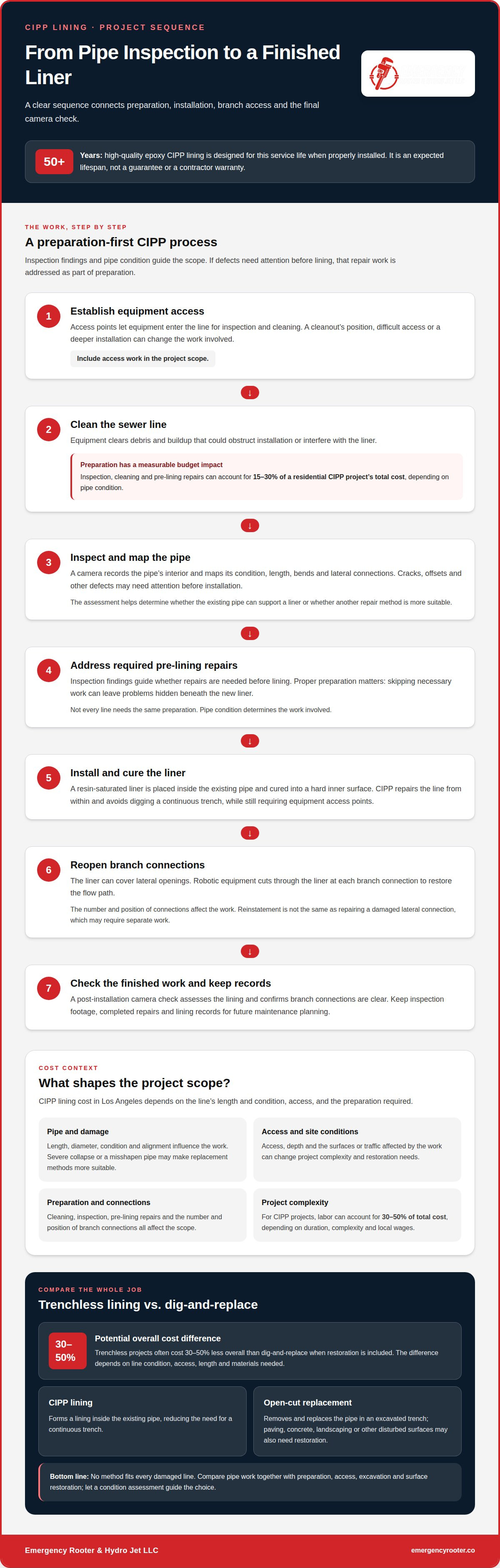
Preparation has a measurable effect on project budgets. Inspection, cleaning, and repairs made before lining can account for 15–30% of a residential CIPP project’s total cost, depending on pipe condition. Cleaning removes buildup that could obstruct the liner. Inspection then reveals cracks, offsets, or other defects that may need attention before installation. Skipping necessary preparation can leave problems hidden beneath the new lining.
A well-planned sequence connects each task to the next. First, equipment clears debris and buildup from the sewer line. A camera inspection then records the pipe’s interior and shows whether damage needs repair. Once the pipe is prepared, the liner can be installed. A post-installation camera check assesses the finished lining and identifies branch connections that need reinstatement.
Cleanout access can add to a project’s scope. A cleanout gives equipment an entry point for inspection and cleaning. Its position matters: difficult access or a deeper installation can change the work involved. Including access work in the project scope helps clarify what the estimate covers.
Lateral reinstatement restores access where a branch line connects to the sewer lateral. The liner can cover these openings during installation. Robotic equipment cuts through the liner at each connection to reopen the flow path. The number and position of branch connections affect the work, so camera footage helps locate them. Reinstatement is different from repairing a damaged lateral connection, which may require separate work.
After installation, keep records of inspection footage, completed repairs, and lining work. These documents show the pipe’s condition and help with future maintenance planning. A later blockage may call for cleaning, while structural damage may require repair or replacement. A long designed service life does not eliminate the need to address new problems.
HOW DOES TRENCHLESS PIPE LINING WORK?
Cured-in-place pipe lining, or CIPP, repairs a sewer line from inside the existing pipe. Equipment first cleans the line and removes material that could obstruct installation. A camera inspection then maps the pipe’s condition, length, bends, and lateral connections. Next, a resin-saturated liner is placed inside the pipe and cured into a hard inner surface. The process avoids digging a continuous trench but still requires access points for equipment.
For a Los Angeles market reference, CIPP lining offers collected on November 9, 2026, ranged from $166 to $235 per linear foot, with a median near $196. This is an aggregate market range, not a project quote or a fixed price. A national per-linear-foot range is not a single dependable figure for every residential job. Length, diameter, access, condition, preparation, and local work requirements change what a line needs.
Per-foot rates help compare similar work, but they don’t explain the full project total. A 3-inch residential lateral and a larger building drain require different liner materials and equipment. A longer pipe may increase material and installation needs, while difficult access can add labor. Cleaning, inspection, and repairs before lining also affect scope. Review the proposed length and included tasks together, rather than multiplying a rate without checking what it covers.
Location matters, too. Plumbing work in Los Angeles can involve different site conditions from a national average, even when pipe diameter and length are the same. A lateral beneath open soil may be easier to access than one beneath concrete or on a crowded property. County boundaries alone do not determine the cost. The route, depth, surface restoration, and connection layout shape the work at each address.
Consider a residential lateral with a branch connection and limited access. A camera inspection locates the connection; cleaning prepares the pipe; and the liner is installed through an available access point. After curing, robotic equipment can reopen the branch connection. Each step adds work that a per-linear-foot figure may not capture. Ask what pipe length was measured, what preparation is included, how reinstatement is handled, and whether the estimate includes surface restoration.
To compare CIPP with excavation, separate pipe work from surface disruption. Open-cut replacement removes the existing pipe and requires digging along its route. Trenchless lining can limit excavation, but suitability depends on the pipe’s condition. A clear estimate should explain the repair method, material, access plan, and finishing work included. This makes a Los Angeles cost comparison more useful than relying on a national average alone.
Resin, liner, and curing-method considerations
A typical residential CIPP project takes 1–2 days; a single sewer line lining is typically completed in one day. Installation places a resin-saturated liner inside the pipe, then cures it into a firm inner surface.
Resin and Liner Considerations
The liner is the flexible material placed inside the existing pipe, and resin hardens it during curing. Liner and resin materials can account for 20–40% of a CIPP project’s total cost. Their specifications affect the finished lining, so the contractor matches material choices to pipe dimensions, condition, and project requirements. Homeowners should see which liner and resin the estimate includes, rather than treating all materials as interchangeable.
Diameter Reduction and Flow Capacity
A cured liner slightly reduces the pipe’s internal diameter, so its thickness matters for flow capacity. CIPP lining typically reduces pipe width by about 1/8 to 1/4 of an inch. A typical 6mm liner in a 4-inch pipe reduces the effective diameter by about 4–5%. The contractor must account for that change when assessing a pipe with existing restrictions or heavy buildup.
Lifespan and Installation Time
CIPP liners are typically built for a 50-year service life, while installation time depends on the project and curing method. Residential CIPP projects commonly take 1–2 days, including preparation and installation. A single lining job may be completed in one day. These timeframes describe typical project duration, not a guarantee for every site; access, pipe length, and repair needs can affect the schedule.
Curing turns the resin-saturated liner into a rigid lining fitted to the pipe’s interior. The chosen curing method determines how the resin hardens and must suit the liner material and job conditions. The sequence matters: the liner is positioned, cured, and checked after installation. The project plan should identify the curing method and explain what work takes place beforehand.
Flow also depends on the finished surface, not diameter alone. A typical 6mm CIPP liner has a Manning’s roughness coefficient of approximately 0.009, compared with 0.013 for older cast iron. That comparison describes surface roughness, not a promise of a specific flow rate in every sewer line. Pipe shape, deposits, connections, and existing damage also influence how wastewater moves through the system.
For homeowners reviewing an estimate, separate material decisions from installation steps. Confirm the stated liner thickness, resin, curing method, and post-installation checks appear in the project scope. A 4-inch line, for example, provides a clear reference for assessing diameter reduction. The pipe’s measured condition and dimensions help explain why a contractor selects a particular liner, while the planned curing process shows how that material becomes a finished lining.
Access, depth, and site-condition cost factors
Access affects how crews reach the pipe, position equipment, and complete the lining. A clear cleanout can provide a direct entry point; a buried or obstructed one may require additional preparation. Depth also affects how the crew reaches the line and handles equipment. A camera inspection maps the route and pipe condition before the work plan is set.
Surface restoration can change the total cost, even when the lined section is the same length. These figures describe restoration work, not the price of CIPP lining itself.
Landscaping creates another cost factor. For a pipe repair beneath planted ground, the route and affected area help determine how much surface work follows excavation. Trenchless lining can reduce digging, but it does not eliminate every access or restoration task.
Street locations bring distinct access challenges. A sewer line beneath a street may require crews to work around traffic and restricted equipment access. A line beneath a driveway, walkway, or landscaped yard also has site-specific constraints. These examples show why location matters as much as pipe length. Camera findings and the planned access point help define the work before installation.
Restoration, landscaping, and site cleanup may account for 5–15% of a typical trenchless project’s total cost. That share can vary with the site and the work required. A project with a clear access point and little disturbed surface has different restoration needs from one crossing concrete or planted ground. Keep lining work and surface restoration visible as separate scope items when reviewing a completed estimate.
For sewer line repair, the price depends on the case and is provided after a quote request; access, depth, pipe condition, and restoration shape the scope. If a damaged line needs attention, request sewer line repair and describe where the pipe runs, such as beneath a driveway or street. Those details help frame the access and site conditions involved.
Emergency Rooter & Hydro Jet
Emergency Rooter & Hydro Jet helps Los Angeles homeowners address sewer and drain problems that may lead them to consider lining or replacement. The right next step depends on the issue: a blockage may call for Drain Cleaning or Hydro Jet Cleaning, while sewer-line damage may require Sewer Line Repair. These services address different problems; clearing a clog is not the same as repairing a damaged pipe.
If recurring backups, slow drains, or a suspected sewer-line problem are disrupting your home, Emergency Rooter & Hydro Jet can help identify the relevant plumbing service. Contact the team to discuss the issue and possible next steps.
Choose the Next Step for Your Sewer Line
Before choosing lining or replacement, determine whether the pipe can be rehabilitated or needs another repair. Understanding CIPP lining cost in Los Angeles starts with the pipe’s condition, access, and project scope. A blockage alone may not call for lining. Note which drains are affected and whether the problem keeps returning, since that pattern can help distinguish a clog from possible structural damage.
A useful CIPP lining cost in Los Angeles estimate should reflect the work required, not just a per-foot figure. Emergency Rooter & Hydro Jet LLC addresses drain and sewer problems: cleaning clears clogs, while structural damage calls for pipe repair. Describe the symptoms and where they occur to clarify the next step.
Contact Emergency Rooter & Hydro Jet LLC to discuss the issue and a practical next step. A clear diagnosis can help you move forward with greater confidence.
Frequently Asked Questions
Can all pipes be lined with CIPP?
No. CIPP requires an existing pipe that can accept and support a liner. A camera assessment can identify a collapse, severe deformation, major offsets, or other damage that may prevent successful lining. For example, a fully collapsed section may need a different repair approach. Pipe material, diameter, access, and the location of the damage also matter. The method suits some damaged lines, not every pipe or failure.
How is sewer relining done?
Sewer relining starts by clearing debris so the liner can contact the pipe wall. A camera inspection identifies the route, defects, and branch connections. The liner is then positioned inside the existing pipe and cured to form a new inner surface. After curing, a camera check reviews the work, and robotic equipment can reopen covered lateral connections. Each stage addresses a different risk, from obstructed installation to blocked branch flow.
How long do results from trenchless pipelining last?
High-quality epoxy CIPP linings are designed for a service life of 50+ years when properly installed. That expected lifespan depends on preparation and installation quality, as well as the pipe’s condition. For example, a liner installed over unresolved defects may face different conditions than one placed after suitable repairs. Keep inspection records and note recurring symptoms, so a later blockage can be distinguished from a structural problem.
How long does it take to complete underground sewer line repair with trenchless methods?
A residential CIPP project commonly takes 1–2 days, but the full repair schedule depends on the work required at that property. Cleaning, inspection, pre-lining repairs, access, and curing all affect completion. For example, a line needing extra preparation can take longer than one ready for lining. The schedule should account for the entire scope, not just the time spent placing the liner.
How long does the installation take?
A single sewer line lining is typically completed in one day, while residential CIPP projects commonly take 1–2 days overall. These describe different scopes: installation is one part of the project, while preparation and other work add time. A line requiring cleaning, repairs, or difficult access can need a longer schedule. Ask for the expected work sequence so you know which tasks are included in the stated timeframe.
Is CIPP Cheaper Than Digging Up My Yard?
CIPP trenchless projects often cost 30–50% less overall than dig-and-replace projects when restoration costs are included. The comparison changes with the site. A route under a driveway, mature landscaping, or other restored surface can make excavation more expensive. CIPP can limit digging, but it still requires preparation and access. Compare the full scope, including restoration, rather than only the pipe work.
What is the average CIPP sewer lining cost in Los Angeles?
There is no single useful average for every Los Angeles sewer-lining project because total cost depends on pipe length, diameter, condition, access, and required preparation. A short interior line and a long underground lateral involve different scopes. Restoration can also affect the total. Use the measured pipe route and the work included in the estimate to understand the project total, rather than relying on one average.
How much does CIPP pipe lining cost per linear foot in Los Angeles?
A collected market snapshot dated November 9, 2026, placed CIPP pipe lining offers between $166 and $235 per linear foot, with a median near $196. It reflects a broad market sample, not a Los Angeles-only rate or a project quote. Local work can differ with pipe condition, length, access, and preparation. Treat a per-foot figure as a comparison point, not a complete project budget.


