
What if several slow drains aren’t separate problems, but signs of one blockage farther down the sewer line? A main sewer line clog Los Angeles homeowners encounter can cause toilets to bubble, sinks to drain slowly, or wastewater to back up in more than one fixture. That’s serious, but it doesn’t automatically mean the pipe is broken.
If multiple fixtures are affected, stop running water and avoid flushing toilets until the situation is assessed. The blockage could be in your private sewer lateral, or the issue could involve the public sewer line. Where the symptoms appear can help guide the investigation, but symptoms alone can’t confirm the cause.
This guide explains the signs of a main-line problem, what to do first, and how a plumber can locate the issue. You’ll learn how a sewer camera can help distinguish a blockage that may respond to rooter service or hydro jet cleaning from pipe damage that may call for sewer line repair. A careful diagnosis helps determine the next step before you assume the worst.
Key Takeaways
- Grease, wipes, tree roots, and pipe scale can contribute to a blockage, but inspection is needed to identify the cause.
- A sewer camera can help locate restrictions or visible pipe defects when the line can be accessed.
- Keep people and pets away from sewage, and avoid direct contact while arranging appropriate cleanup.
- Rooter clearing and hydro jet cleaning serve different purposes; the right approach depends on the blockage and pipe condition.
- A main sewer line clog Los Angeles property owners suspect calls for diagnosis first, not an automatic assumption that the pipe needs replacement.
How to recognize a main sewer line clog in Los Angeles
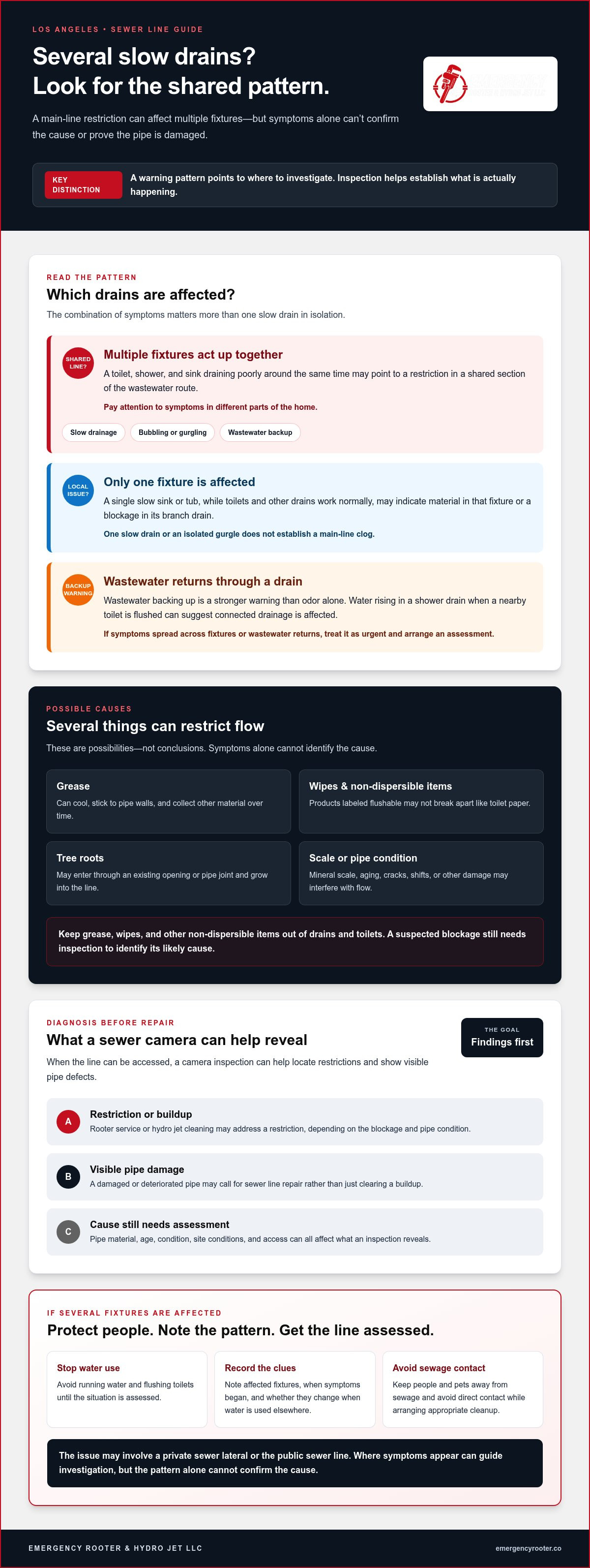
Several fixtures acting up at once deserve attention. If a toilet, shower, and sink are all draining poorly around the same time, the trouble may be beyond any one fixture’s branch drain, in a shared section of the home’s wastewater route. A main sewer line clog is a restriction in the shared pipe that carries wastewater away from multiple fixtures.
That pattern is a warning, not a diagnosis. Slow drainage, gurgling, and unpleasant odors can have more than one cause. Symptoms alone can’t confirm where a restriction is or whether the pipe is damaged. Household drains connect to larger sewerage systems, so a problem in a shared section can affect multiple fixtures. An inspection is needed to assess the specific line.
Which symptoms suggest a shared sewer-line problem?
Look for a cluster of symptoms, especially in fixtures in different parts of the home. More than one toilet may flush slowly, or a sink, shower, and floor drain may all struggle to clear. Note when the symptoms began and whether they change when water is used elsewhere. This pattern is more useful than judging one drain in isolation.
Bubbling or gurgling can happen as water moves through a restricted line and air shifts in the connected plumbing. Wastewater backing up is a stronger warning than odor alone. For example, water rising in a shower drain when a nearby toilet is flushed suggests a problem affecting connected drainage. A sewer smell without slow drainage or backup is worth noting, but it doesn’t prove there’s a main-line blockage.
When does one clogged fixture point to a different problem?
If only one sink or tub drains slowly while toilets and other drains work normally, the issue may be local. Hair or other material in a fixture, or a blockage in that fixture’s branch drain, can affect one spot without restricting the shared sewer route. Don’t assume a main-line clog from one slow drain or isolated gurgle.
Check the full pattern before drawing conclusions. Note which fixtures are affected, whether wastewater has backed up, and whether the symptoms started around the same time. A main sewer line clog Los Angeles property owners suspect should be assessed from that combined picture, not a single clue. If symptoms spread to multiple fixtures or wastewater returns through a drain, treat the situation as urgent and arrange an assessment. The pattern points to where to investigate; it doesn’t prove the cause or establish pipe condition.
What causes a main sewer line clog in Los Angeles homes?
A blockage can build from everyday waste, material entering the line, or changes inside the pipe. Several causes are possible, but no symptom can identify one for certain. Symptoms identify a concern; inspection helps establish its cause. Clearing a buildup is different from addressing a damaged or deteriorated pipe, so it matters to understand what is restricting the line.
How can grease and flushed items contribute to a blockage?
Grease may look harmless while it’s warm and liquid. As it cools inside a drain line, it can stick to pipe walls and collect other material over time. Wipes and products labeled flushable may also fail to break apart like toilet paper. Keep grease, wipes, and other non-dispersible items out of drains and toilets. Los Angeles County Sanitation Districts resources offer local guidance on keeping these materials out of the wastewater system.
These habits can contribute to restrictions, but they don’t prove what’s happening in a particular home. When assessing a suspected main sewer line clog Los Angeles residents are dealing with, a technician considers the symptoms and inspects the accessible line before identifying the likely cause.
Can roots, scale, or pipe condition also restrict flow?
Yes, though each is a possibility, not an assumption. Roots can enter through an existing opening or pipe joint and grow into the line. Mineral scale may narrow the passage, while an aging, cracked, shifted, or otherwise damaged pipe can also interfere with flow. A camera inspection, where access allows, can help show whether there’s buildup, a visible defect, or another restriction.
Pipe material, age, condition, and site conditions all affect what an inspection may reveal. Two nearby homes can have different pipe layouts and different causes. Tree-root intrusion is one possibility, not the default explanation for every blockage. The tree roots in sewer lines guide covers that concern in more detail.
For an assessment, note which fixtures are affected, when the trouble began, whether drainage changed recently, and whether anyone has flushed wipes or poured grease into a sink. These details help a technician narrow the possibilities, but they don’t replace examining the line. Rooter service or hydro jet cleaning may address a restriction, while visible pipe damage may call for sewer line repair. The appropriate next step depends on the inspection, not guesswork.
If several drains are affected or wastewater is backing up, an assessment can help identify the problem before a repair is chosen. Emergency Rooter & Hydro Jet LLC assesses suspected sewer-line blockages and determines whether clearing or repair fits the findings.
How plumbers diagnose a main sewer line clog, and distinguish damage
A backup can look alarming, but it doesn’t tell you whether the line is clogged, damaged, or both. Diagnosis separates what symptoms suggest from what the pipe condition shows. A plumber can assess the private line, explain the inspection findings, and choose a response based on those findings rather than assuming a clog means a broken pipe.
The process usually follows a clear sequence:
- Describe the symptoms. Explain which fixtures are affected, when the trouble started, and whether water or wastewater has backed up. Mention any recent changes that may help narrow the investigation.
- Locate an access point. The plumber identifies a suitable place to reach the sewer line. What can be assessed depends on available access and the pipe layout.
- Assess the line. A sewer camera may be used to view the accessible pipe, locate a restriction, or identify visible defects.
- Choose the response. Findings help determine whether clearing may address the blockage or visible pipe damage calls for further assessment and repair.
What does a sewer camera inspection help reveal?
A camera view can help show where a restriction is and what the inspected portion of the pipe looks like. Depending on access and visibility, it may reveal buildup or defects such as cracks. It’s a diagnostic tool, not a guarantee that every hidden defect will be found. The results apply to the portion the camera can inspect, so ask for an explanation of any limits.
Camera inspection and clearing are separate actions. The camera helps assess the line; rooter service or hydro jet cleaning may clear a restriction when appropriate. A blockage can exist without a broken pipe, and seeing a blockage doesn’t by itself prove repairs are needed. The method depends on the obstruction and observed pipe condition.
When might diagnosis point beyond a removable clog?
Visible damage, a restriction that remains after clearing, or recurring symptoms can be reasons for closer assessment. They are clues, not automatic proof that a full repair is necessary. The next decision should follow the inspection. Depending on the findings, the response may involve clearing, additional evaluation, or sewer line repair options.
For a suspected main sewer line clog Los Angeles property owners should ask for a clear explanation of what was observed, where it was found, and why the proposed response fits. That makes it easier to distinguish an immediate blockage from a pipe-condition issue and avoid treating every backup as a replacement job. A licensed and insured plumbing team can assess the accessible line and connect the diagnosis to an appropriate rooter, hydro jet, or repair response.
If multiple fixtures are affected or wastewater is backing up, Emergency Rooter & Hydro Jet LLC can assess the sewer line so the next step is based on the condition observed, not the symptom alone.
Handling a Suspected Main Sewer Line Clog in Los Angeles
Wastewater backing up inside the property? Act first, then sort out the cause. Stop using toilets, sinks, showers, and other water fixtures that drain into the affected line. Adding more water can worsen an active backup. Keep children and pets away from sewage, and avoid touching it. If cleanup is needed, follow appropriate public health guidance rather than risking direct contact.
A backup inside the home points to a private plumbing concern; sewage appearing in the street or public right-of-way may involve public infrastructure. The location is a useful clue, not a confirmed diagnosis. A public-side concern and a private-line blockage can require different contacts, so don’t assume who is responsible based on symptoms alone.
When should you contact a local sewer agency?
If sewage is visibly backing up in the street or public right-of-way, contact the agency responsible for that location. Service boundaries vary across the Los Angeles area, so identify the agency serving the property. The Los Angeles County Sanitation Districts can be a reference where their service area applies, but they don’t serve every address in Los Angeles County.
When should you arrange private-line plumbing help?
If wastewater is backing up inside the home, or several fixtures are affected, arrange for a licensed plumber to assess the private plumbing line. The first goal is to locate the issue and understand the pipe condition, not to presume replacement is necessary. The findings can distinguish a blockage that may be cleared from damage that needs further attention.
Once immediate water use has stopped and people are clear of sewage, record details if it’s safe to do so. Note which fixtures are affected, when the backup began, and whether it appeared during a specific activity, such as flushing or running a sink. A photo taken from a safe distance may help document where wastewater appeared. Don’t spend time documenting if the backup is still spreading or creating an immediate hazard.
Share those observations with the professional assessing the line. The location and timing of symptoms provide useful context, and an inspection of the accessible private pipe can help guide the response. For a suspected main sewer line clog Los Angeles property owners are facing, diagnosis helps prevent an unnecessary repair based on symptoms alone.
If the backup is inside your property, Emergency Rooter & Hydro Jet LLC provides emergency plumbing help for sewer backups. For additional guidance on urgent plumbing situations, see the emergency plumber guide.
How professional main-line clearing restores flow, and what happens next
Clearing is the right move only when the pipe’s condition and type of blockage support it. A suspected main sewer line clog Los Angeles homeowners face may call for mechanical rooter clearing, hydro jet cleaning, or a different next step if inspection shows pipe damage. The goal is to restore flow without treating every obstruction the same way.
How do rooter clearing and hydro jet cleaning differ?
Rooter service uses mechanical clearing to break through or remove an obstruction. Hydro jet cleaning uses high-pressure water to clean material from the line. Both can help address certain blockages, but neither suits every pipe or situation. The obstruction, available access, and observed pipe condition guide the choice. For more detail, see the rooter service guide and the hydro jetting guide.
These are clearing methods, not pipe repairs. A camera inspection may help assess the line, but cleaning alone doesn’t establish that the pipe is free of damage or prevent every future clog. If the pipe appears compromised, its condition should be considered before choosing a clearing method. Diagnosis comes first, and the response should match what the inspection shows.
What should happen after the blockage is cleared?
After clearing, flow can be reassessed to see whether fixtures are draining as expected. If slow drainage or backup returns, further inspection may be needed to look for a remaining restriction or a pipe-condition issue. Recurring symptoms don’t automatically mean the line needs replacement, but they shouldn’t be dismissed as a one-time clog either.
If inspection reveals damage, repair assessment is a separate step. The plumber can explain what was observed and whether sewer line repair is appropriate. A clear account of the findings helps you understand why clearing may be enough or why the line needs further work.
Emergency Rooter & Hydro Jet LLC provides licensed and insured plumbing service, including 24/7 emergency plumbing in Greater Los Angeles. Its team provides rooter service, hydro jet cleaning, and sewer line repair. The appropriate response depends on the condition observed, so don’t assume replacement is needed before the line is assessed.
For a suspected sewer-line clog, Emergency Rooter & Hydro Jet LLC provides help assessing and addressing the blockage.
Take the next step with a clear diagnosis
Don’t wait for certainty before acting on an active backup. Focus on protecting the property and getting a clear assessment of the line. A main sewer line clog Los Angeles homeowners suspect is easier to address when the next decision is based on what a plumber finds, not a guess about the cause.
As you arrange help, keep your description simple: where the problem is showing up, what changed, and whether wastewater is still backing up. That gives the plumbing team a useful starting point. From there, you can understand the finding and the reason for the recommended next step before work proceeds.
Emergency Rooter & Hydro Jet LLC is licensed and insured in California, license #574013, and provides emergency plumbing in Greater Los Angeles, including Beverly Hills, Los Angeles, and Santa Monica. The company reports a 45-minute average arrival time, not a guaranteed response. Contact Emergency Rooter & Hydro Jet LLC for an assessment of a suspected sewer line clog.
Frequently Asked Questions
Can I use chemical drain cleaner for a main sewer line clog?
Avoid repeated chemical treatments for a suspected main sewer line clog, especially if wastewater is standing in a fixture. The products may not reach the obstruction, and chemicals can remain in the water or pipe. Never mix drain cleaners or add another product after using one. If several fixtures are affected, stop running water and arrange an assessment. Tell the plumber what product you used and when, if applicable.
Will a sewer camera inspection clear the clog?
No. A sewer camera helps a plumber view the accessible pipe and locate a restriction or visible condition; it doesn’t remove the blockage. Clearing requires a separate method selected for the findings and access. For example, the camera may help show whether material is obstructing the line, while mechanical clearing addresses the obstruction. A camera may also assess the inspected section afterward, but it can’t guarantee every hidden issue has been found.
Does homeowners insurance cover a main sewer line clog?
It depends on your policy, the cause, and whether sewer or water-backup coverage applies. Insurers may treat gradual maintenance issues differently from sudden damage, but policy language varies. Review your documents and contact your insurer about the specific incident before assuming a repair is covered. Keep dated photos of affected areas, notes about when the backup began, and the plumber’s written findings to support the discussion.
Are products labeled flushable safe to put down the toilet?
Not necessarily. A “flushable” label doesn’t mean a wipe breaks down like toilet paper once it enters the wastewater system. Wipes and other non-dispersible items may contribute to restrictions farther along the line. Follow local wastewater guidance, and put wipes in the trash when directed. The Los Angeles County Sanitation Districts provides public information about items that should stay out of wastewater systems.
Can a main sewer line clog clear itself?
A brief improvement doesn’t prove the line is clear. Water may pass temporarily if material shifts, then drainage trouble can return as more wastewater enters the pipe. For instance, a toilet may flush once without backing up even though the underlying restriction remains. If the same fixtures slow down again, or symptoms return during normal use, treat the improvement as temporary and arrange an assessment rather than relying on it.
How long does it take to clear a main sewer line clog?
There’s no reliable universal duration. Time depends on the blockage’s location and cause, access to the line, and whether inspection reveals damage that needs separate work. A reachable obstruction is different from a difficult-to-access section or a damaged pipe. A plumber can give a useful estimate after assessing the property and findings. This applies whether the home is in Beverly Hills, Los Angeles, or Santa Monica.


